

Keeping Affordable Homes Affordable: Turning Energy Scores into Real Repairs
A number from one to ten won't insulate an attic. It won't take notes and photos to prepare a contractor. But it can give someone a reason to do both.
In September, I went to Michigan to find people willing to test this very idea: can a home assessment that starts with a simple 1-10 score act as a springboard for getting real work done.
By way of introduction from the GreenHome Institute, I found Jason King, Construction Project Coordinator at Habitat for Humanity Capital Region in Lansing. He is already doing this. His affiliate uses the Department of Energy’s Home Energy Score (HES) to produce a 1-10 home score with simple recommendations. It is a starting point for making improvements.
This was music to our ears. Kevin Brauer, Green Home Club’s technical director, upon hearing of the meeting told me that his local Habitat group had a real understanding and appreciation of building science. They have deep roots. When Jimmy Carter, Habitat's best-known volunteer, lent his name to the 2003 Jimmy Carter Work Project in LaGrange, Georgia, the Department of Energy's Building America program helped it build 19 ENERGY STAR homes.
DOE's broader work with Habitat affiliates covered insulation, air sealing, ventilation and moisture management. In Denver, Bruce Carpenter, then construction manager at Metro Denver Habitat, told the media why this is important: "It's not fair to our families if their energy bill is higher than their mortgage."
In Lansing, this is one of their major concerns as well. Brent Taylor, Habitat Capital Region's president and CEO, has described building affordable homes as only one part of a larger job: preparing families to succeed as owners, with budgeting, financial education and ongoing support. In a video about the affiliate's homeownership program, one mother explained why she did the work in five words: "My children, they're my motivation."
Jason helps coordinate repairs to existing homes, with subcontractors doing the work. He uses an inspection checklist developed by the GreenHome Institute to gather health, safety, repair information along with information needed for the Home Energy Score .
The score also helps meet a funding requirement. As Jason explained when we spoke in September: "the funding that we're working with requires some kind of energy comparison."
HES was one of the easiest ways to get that comparison, he said, as it comes with modeled energy use and estimated savings.
But the next step is just as important: helping households use the assessment to plan real work.
That’s where our software, the Green Home Predictor, comes in; we’ve heard from many critics of the Home Energy Score that its project recommendation engine is lacking in depth.
I just needed to listen to Jason’s pain points.
First, there is organizing all the photos he takes. Photos and his notes help him write scopes later without driving back to check every detail. Jason typically takes 75–150 pictures during an assessment. That used to be a few camera rolls.
He also described writing much the same scope language over and over while keeping it accurate for each home. For a nonprofit juggling multiple projects, that type of care and feeding eats into staff time. It is unnecessary because it is something an automated software program like ours is really good at.
Our mini-pilot started with one house and one Home Energy Score report. Later, Jason sent fuller inspection notes and an inspection report with photo links and the address and homeowner’s name taken out. Now we had more to work with. Could GHP make useful planning material out of those photos of insulation, equipment, ventilation and the other things that turn up when you look closely at a house?
It’s not just what you know that counts; it also has to keep track of what we didn't know. For example, an assumed attic insulation value had to stay an assumption as we passed the inspection file back and forth. The software shouldn’t promote "probably" into "verified."
On October 2, Jason wrote back:
"Yes, I thought it provided a straight-forward, organized process that was very useful towards developing a workscope. Especially for organizations that do a lot of projects at once, I can see that it would cut down on errors and save valuable time in developing scopes."
He liked the guide and the dropdowns that let him change information. He also saw promise in the RFP feature for reducing repetitive scope writing. That was encouraging feedback from someone who does this work. We still have to measure the hours and errors saved.
Jason also asked whether photos could be brought into the GHP and stay with the Home Facts and help fill in missing information.
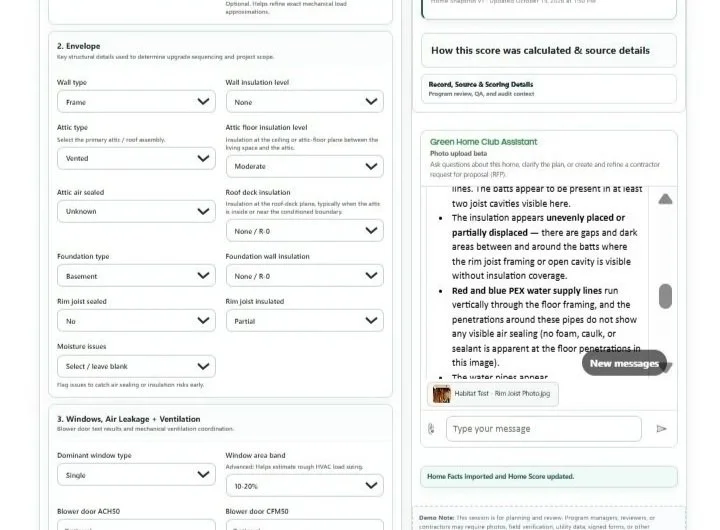
Photo discussion is now available in the Green Home Predictor workspace. Photos can support questions and review without automatically changing the saved facts.
To find out, we added photo processing functionality back into our GHP chatbot app. We’d taken it away in March because of concern about file size, but we found a way to reduce the photos before they hit the chatbot that seems to work well. Now photos from a walkthrough or supplied by the homeowner can travel with the record and be selected for discussion. They could help someone spot a detail, read a label or ask a better question.
Habitat gives this idea a very practical setting, with repairs to coordinate and subcontractors who need a clear scope.
Jason was careful to point out that Habitat affiliates work differently. His is one affiliate's repair program. I added that we only tested one home together so far.
Next we need a few more homes and something decidedly low-tech: a clock. How long does a workscope take? What needs correcting? Do the photos and notes save a return visit?
That's the job I want GHP to earn: less repetitive paperwork, clearer contractor requests and more time saved and clearer workscopes for the people doing the work.
