

On the Road with the Green Home Predictor
Publication update: This article is now also published by the Building Performance Association. Read “Turning an Energy Audit Into Better Renovation Decisions” in BPA Journal →
The other day I was sitting in one of the many chairs in one of the many rooms of my dentist. I’d been shuffled from the waiting room to the hygienist, who, after taking some images, looked at the screen.
Of course, I had to ask about AI. The hygienist told me to wait for the dentist because he knew all about that stuff.
The dentist walked in, and AI seemed far from his mind. He wanted to continue our conversation about pole walking, using sticks on a walk to enhance it to the point of a workout, something he pledged to try but hadn’t gotten around to. I told him it was a good way to see the Twin Cities.
When we finally got around to how he uses software, he said he likes it because he can not see everything, and the AI part has been very helpful in diagnosing X-rays and making him more confident in recommending the treatment plan.
That made the comparison between dentistry and fixing old houses I'd been thinking about even clearer to me.
If there were ever cases of complicated problems, years of growing cavities and rot often hidden by years of feeble fixes, that would be the old houses we live in and work on.
Fortunately, home performance is like dentistry, in that there are a bunch of new tools to help us see what’s going on:
- fill-in-the-blank energy assessments like the DOE’s Home Energy Score (HES),
- a Manual J, now with LIDAR,
- blower-door results,
- infrared photos,
- high-definition photos,
- equipment labels,
- panel photos,
- homeowner complaints,
- utility bills, and calibration tools to increase their usefulness,
- Zillow and Google Maps can help sometimes.
The problem is that the more tools we add, the more different people are involved, the more confused the homeowner becomes, and a treatment plan does not naturally become a clear, logical next step.
That’s where the Green Home Predictor (GHP) comes in. Yes, it uses AI, but not the “ask AI anything” kind. The point is not to throw a pile of house facts into a chatbot and hope for wisdom. The point is to guide the information through a known home-performance workflow, inspired by the logic behind the Department of Energy’s Home Energy Score and supported by the tools, programs, and resources the industry already uses. Upload an existing audit or complete the fill-in-the-blank walkthrough, and GHP helps review the findings, flag missing facts, identify what needs verification, and sequence the contractor Workscope. In other words, it takes the confusion and adds a layer of simplicity that leaves homeowners more confident in taking the next right steps.
Does It Work?
I enlisted the help of an experienced home energy assessor Kevin Brauer of Home Performance Strategies. Kevin has decades of experience in the home-performance field and is among the best advocates for the industry in the country. He is also a Green Home Predictor advocate who uses the tool with his clients.
We decided we would look at three homes in various states of performance and see whether using the GHP made sense. I did not have the budget for a large state or university backed study.
For each home, we looked at two kinds of scores. We used the Home Energy Score's unofficial demonstration version to help describe the house’s overall energy performance in BTUs and whatnot. The Green Home Predictor (GHP) score looked at something different: how ready the evidence was to become a clear, sequenced, contractor-ready scope and then, provide a treatment plan for each home. The Predictor can read a Home Energy Score report with one click. Or, the fields can be entered into the Predictor manually.
#1 Janet — When the House Needs a Whole-Home Treatment Plan, Not a Sales Pitch
Janet’s home was the basic weatherization case: a 1950s house with major envelope issues, high leakage, low attic and wall insulation, uninsulated foundation walls, duct concerns, and a limited electrical panel.

The Home Energy Score acted like the report card. It showed the house was performing poorly and pointed to familiar energy improvements. GHP acted more like the treatment plan. It did not simply say “do everything.” It organized the work into a sequence: verify assistance programs, check exhaust and moisture, address attic air sealing before insulation, look at the cold bedroom over the garage, and treat electrification as planning-only until the panel was understood.
Janet: From Report Card to Treatment Plan
| What HES showed | What GHP did with it | Why it mattered |
|---|---|---|
| HES gave Janet’s home a low score: 2 today, with estimated annual savings of $804. | GHP classified the home as Band 1: Legacy Home / Score 18. | Both tools pointed to the same conclusion: this was a basic weatherization-first house, not a fancy remodel case. |
| HES showed high leakage: 2,400 CFM50, with “Air sealed? No.” | GHP used the same leakage number, labeled the home leaky, and made attic air sealing and insulation a high priority. | The problem was not whether the house leaked. The question was what to do first. |
| HES recommended attic insulation, basement/foundation insulation, air sealing, duct sealing, and duct insulation. | GHP turned those findings into a sequence: diagnostics first, moisture and exhaust checks, then envelope and comfort work. | This moved Janet from a list of improvements to an actual order of operations. |
| HES does not fully capture trust, timing, or electrification readiness. | GHP added guardrails: verify assistance programs first, do not jump to electrification, and do not budget a heat pump before understanding the 60-amp panel. | Janet understood the roadmap and specifically noticed the importance of not getting a heat pump before an electrical panel upgrade. |
Janet’s home did not need a fancy debate. The score pointed toward basic weatherization, health and safety checks, and envelope work first.
Janet’s response was the evidence I cared about most. She said the information gave her a road map, especially an order of importance. She also said it was easier to trust because the goal was education, not selling a product or service.
“It provided me a road map of the work that needs to be done, and most crucially, an order of importance.”
#2 Maddy — Find the Right Nail
Maddy’s home was the remodel-timing case. She had already paid an architect, pulled a kitchen permit, committed to construction, and reached the point where walls, floors, and access might soon close. That made the question different from Janet’s. This was not a “start everywhere” weatherization case. The attic was already strong. The better question was: before the remodel moves forward, what should be checked while there is still time?
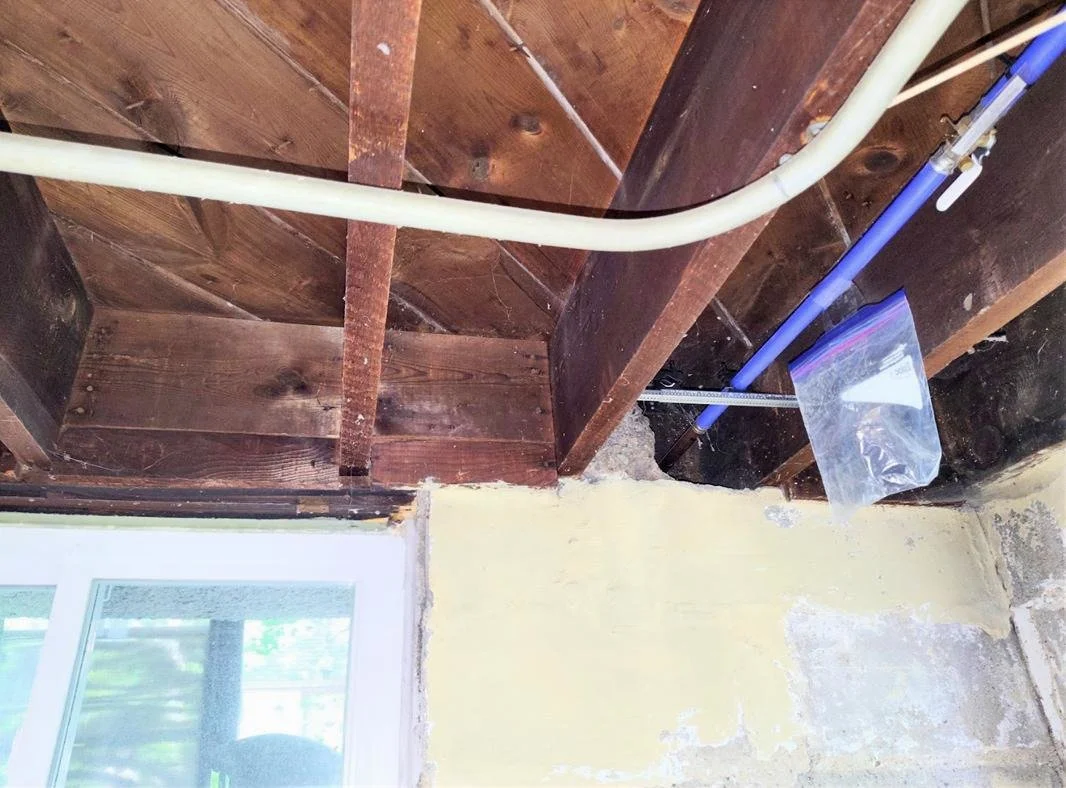
After reviewing our packet, Maddy understood both its value and its limits. Her budget was already committed to an addition and kitchen project, so she was not ready to add another major scope. But that was part of the point. She wrote that the documents would be useful when she tackled additional work the following year, and she especially appreciated knowing “what to ask a contractor about in order to ensure quality work.”
That is a real success. GHP did not pressure her into doing more. It helped her avoid making the wrong decision too soon.
The best moment at Maddy’s house came at the kitchen table. Maddy had shared the GHP packet with her architect, Derk. While we reviewed his plan for the kitchen and addition, Derk looked at Kevin and said there should be space for him on the creators’ list in the left-hand column of the plan, alongside the logos of the firms and resources used to create it. Meaning: energy performance is that important.
That is what I call a seat at the table.
Maddy shows that the best time to introduce whole-home thinking may be when the homeowner is already remodeling. The goal is not to interrupt the project. The goal is to ask, before the walls close: what should we verify now so the next decision is better?
Maddy: From Report Card to Handoff
| Decision point | What HES showed | What GHP did with it | Why it mattered |
|---|---|---|---|
| Overall performance | HES gave Maddy’s home a low score: 1 today, with a possible improvement score of 4 and estimated annual savings of $545. | GHP classified the home as Band 2: Mixed Era Home / Score 30. | Both tools showed the house had real performance opportunities, but this was a timing case, not a generic whole-house package. |
| Attic | HES showed the attic already had R-49 insulation. | GHP confirmed attic insulation was high and attic air sealing was yes. | This kept the project from becoming a “swing the hammer at the attic” case. The attic was not the main problem. |
| Lower boundary / front den | HES showed an R-0 basement/foundation condition and recommended insulating above unconditioned space. | GHP connected that finding to Maddy’s cold front den, the crawlspace/basement transition, rim joist, sill, and floor-edge questions. | This turned a general recommendation into the real homeowner question: what is happening under the cold room? |
| Contractor handoff | HES identified improvement categories and savings. | GHP produced contractor questions, quote priorities, deferred items, and guardrails. | Maddy got practical language for what to ask before hiring, without being pushed into extra work during an already expensive remodel. |
#3: Jeff — Evidence-to-Scope Mode
Jeff was already moving. He had already bought into the whole-home idea. Walls had been insulated. Knob-and-tube wiring had been removed through major parts of the house. Kitchen and electrical upgrades were finished. He now had a Manual J, blower-door data, IR photos, attic photos, and auditor observations when we ran the Predictor.
He did not need a generic sales pitch. He needed the next scope.
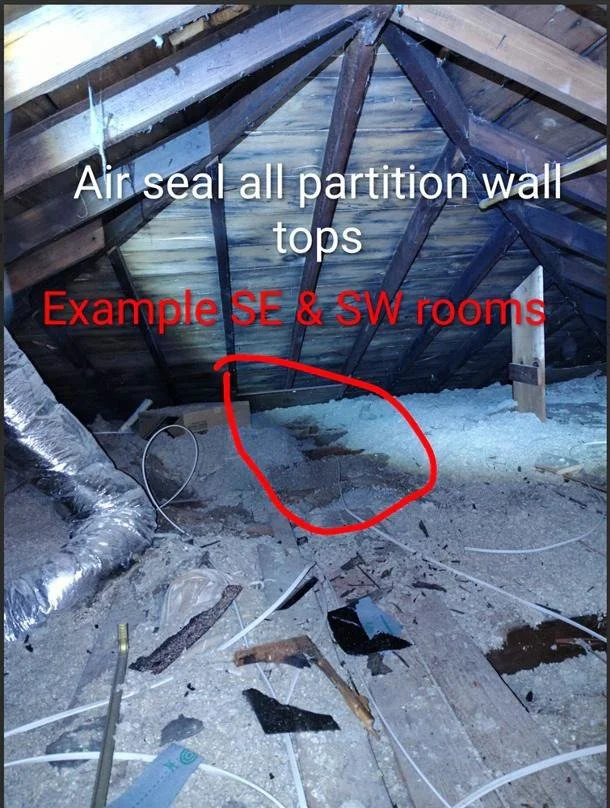
HES was the report card. Jeff’s home scored 3 today, with estimated annual savings of $73. The HES report showed a house that was already partly improved: R-11 walls, R-11 foundation walls, double-pane windows, and measured air leakage of 2,200 CFM50. But the attic still stood out. HES listed attic floor insulation at R-9 and recommended increasing attic insulation.
GHP was the treatment plan. It read Jeff’s home as a Band 3: Improved Shell / Legacy Systems home with a starting score of 47. That is different from Janet and Maddy. This was not a house where every basic measure was missing. The walls were strong, the foundation was improved, and the rim joist was listed as sealed and insulated. The remaining weak point was the attic: GHP flagged attic insulation and air sealing as high priority and noted that auditor IR photos should guide air sealing first.
Jeff's house shows that even motivated homeowners need help keeping complex projects moving in the right order. The evidence existed. The Manual J, blower-door result, IR photos, attic photos, and audit observations were all useful. But evidence alone is not a scope.
The missing piece was the handoff.
For Jeff, GHP’s value was turning technical evidence into a contractor-ready question.
Jeff: From Evidence to Scope
| Decision point | What HES showed | What GHP did with it | Why it mattered |
|---|---|---|---|
| Overall performance | HES gave Jeff’s home a score of 3 today, with estimated annual savings of $73. | GHP classified the home as Band 3: Improved Shell / Legacy Systems / Score 47. | This was not a beginner weatherization case. The house had already been improved, but it still needed the next precise scope. |
| Existing improvements | HES showed R-11 walls, R-11 foundation walls, double-pane windows, and air leakage at 2,200 CFM50. | GHP read the walls as high, the foundation as code-level/R-15, and the rim joist as sealed and fully insulated. | GHP did not start over. It recognized the work already done and focused on what still mattered. |
| Attic weakness | HES showed attic insulation at R-9 and recommended increasing attic floor insulation. | GHP flagged attic insulation and air sealing as high priority and noted that IR photos should guide air sealing first. | Both tools pointed to the attic, but GHP turned that finding into a contractor conversation. |
| Workscope handoff | HES identified attic improvement as the main recommendation. | GHP’s Workscope sequenced the job: verify attic conditions, check safety issues, confirm bath-fan venting, air seal top plates and penetrations, then insulate. | This is the handoff: not just “add insulation,” but how to do the work in the right order. |
| Prediction scenario | HES showed the attic as the key improvement area. | GHP modeled a scenario where attic insulation became high, attic air sealing became yes, and leakage dropped from 2,200 CFM50 to 1,500 CFM50. | In that scenario, the GHP score rose from 47 to 60, giving Jeff a practical reason to take the attic-first scope seriously. |
In a perfect world, every homeowner would be ready for a whole-home retrofit package. But this is not a perfect world. Janet needed a roadmap. Maddy needed timing. Jeff needed the next scope. We have to meet homeowners where they are and help them make the next better decision. After weighing the facts, that is exactly where GHP comes in. It gives the next right step.
