

We’re in the news…
We're In The News!
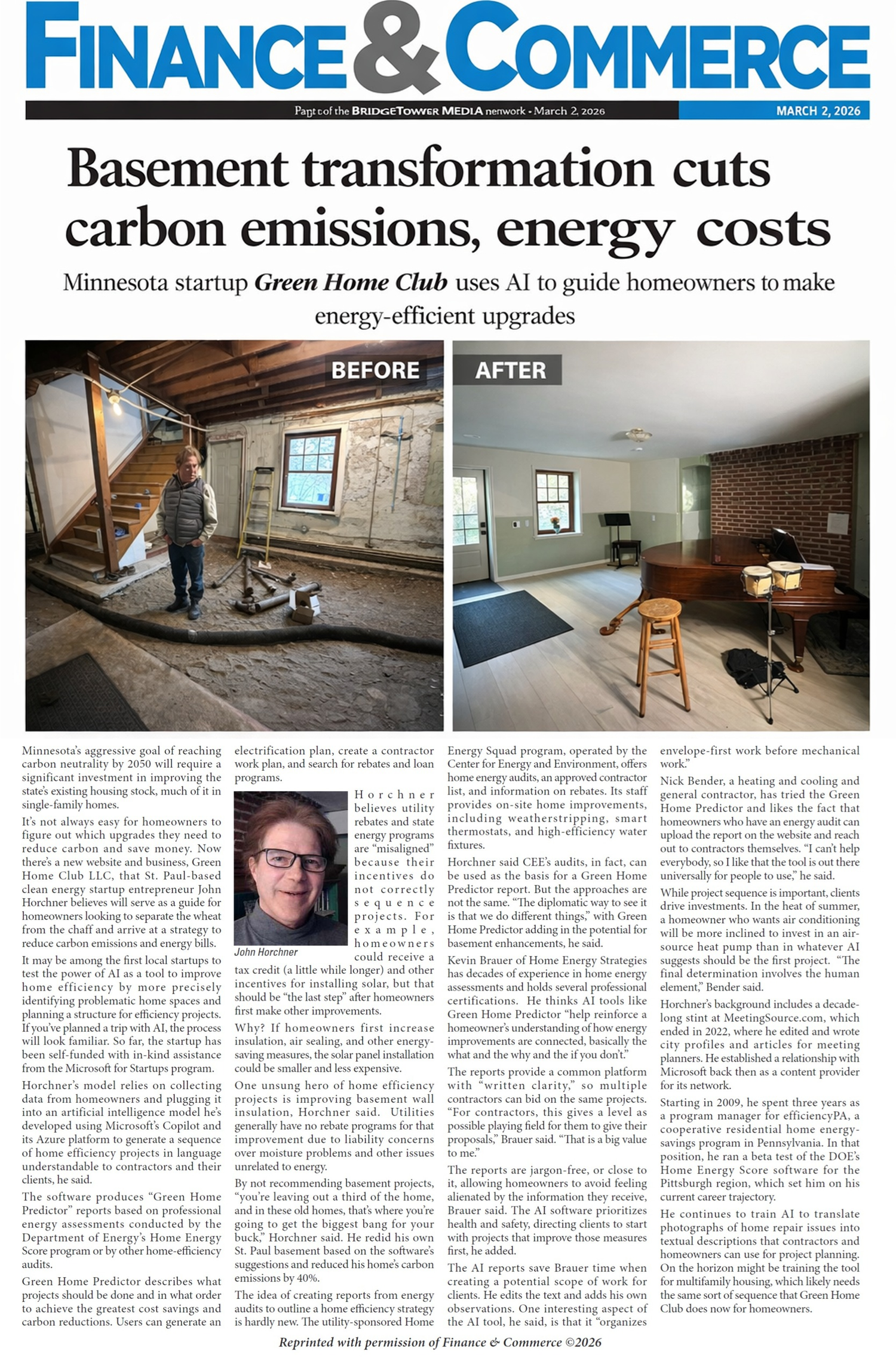
Sustainable: AI startup guides homeowners to cut carbon, costs
Finance & Commerce | March 2, 2026
Minnesota’s aggressive goal of reaching carbon neutrality by 2050 will require a significant investment in improving the state’s existing housing stock, much of it in single-family homes.
It’s not always easy for homeowners to figure out which upgrades they need to reduce carbon and save money. Now there’s a new website and business, Green Home Club LLC, that St. Paul-based clean energy startup entrepreneur John Horchner believes will serve as a guide for homeowners looking to separate the wheat from the chaff and arrive at a strategy to reduce carbon emissions and energy bills.
It may be among the first local startups to test the power of AI as a tool to improve home efficiency by more precisely identifying problematic home spaces and planning a structure for efficiency projects. If you’ve planned a trip with AI, the process will look familiar. So far, the startup has been self-funded with in-kind assistance from the Microsoft for Startups program.
Horchner’s model relies on collecting data from homeowners and plugging it into an artificial intelligence model he’s developed using Microsoft’s Copilot and its Azure platform to generate a sequence of home efficiency projects in language understandable to contractors and their clients, he said.
The software produces “Green Home Predictor” reports based on professional energy assessments conducted by the Department of Energy’s Home Energy Score program or by other home-efficiency audits. Green Home Predictor describes what projects should be done and in what order to achieve the greatest cost savings and carbon reductions. Users can generate an electrification plan, create a contractor work plan, and search for rebates and loan programs.
Horchner believes utility rebates and state energy programs are “misaligned” because their incentives do not correctly sequence projects. For example, homeowners could receive a tax credit (a little while longer) and other incentives for installing solar, but that should be “the last step” after homeowners first make other improvements. Why? If homeowners first increase insulation, air sealing, and other energy saving measures, the solar panel installation could be smaller and less expensive.
One unsung hero of home efficiency projects is improving basement wall insulation, Horchner said. Utilities generally have no rebate programs for that improvement due to liability concerns over moisture problems and other issues unrelated to energy. By not recommending basement projects, “you’re leaving out a third of the home, and in these old homes, that’s where you’re going to get the biggest bang for your buck,” Horchner said. He redid his own St. Paul basement based on the software’s suggestions and reduced his home’s carbon emissions by 40%.
The idea of creating reports from energy audits to outline a home efficiency strategy is hardly new. The utility-sponsored Home Energy Squad program, operated by the Center for Energy and Environment, offers home energy audits, an approved contractor list, and information on rebates. Its staff provides on-site home improvements, including weatherstripping, smart thermostats, and high-efficiency water fixtures.
Horchner said CEE’s audits, in fact, can be used as the basis for a Green Home Predictor report. But the approaches are not the same. “The diplomatic way to see it is that we do different things,” with Green Home Predictor adding in the potential for basement enhancements, he said.
Kevin Brauer of Home Energy Strategies has decades of experience in home energy assessments and holds several professional certifications. He thinks AI tools like Green Home Predictor “help reinforce a homeowner’s understanding of how energy improvements are connected, basically the what and the why and the if you don’t.”
The reports provide a common platform with “written clarity,” so multiple contractors can bid on the same projects. “For contractors, this gives a level as possible playing field for them to give their proposals,” Brauer said. “That is a big value to me.”
The reports are jargon-free, or close to it, allowing homeowners to avoid feeling alienated by the information they receive, Brauer said. The AI software prioritizes health and safety, directing clients to start with projects that improve those measures first, he added.
The AI reports save Brauer time when creating a potential scope of work for clients. He edits the text and adds his own observations. One interesting aspect of the AI tool, he said, is that it “organizes envelope-first work before mechanical work.”
Nick Bender, a heating and cooling and general contractor, has tried the Green Home Predictor and likes the fact that homeowners who have an energy audit can upload the report on the website and reach out to contractors themselves. “I can’t help everybody, so I like that the tool is out there universally for people to use,” he said.
While project sequence is important, clients drive investments. In the heat of summer, a homeowner who wants air conditioning will be more inclined to invest in an air source heat pump than in whatever AI suggests should be the first project. “The final determination involves the human element,” Bender said.
Horchner’s background includes a decade long stint at MeetingSource.com, which ended in 2022, where he edited and wrote city profiles and articles for meeting planners. He established a relationship with Microsoft back then as a content provider for its network.
Starting in 2009, he spent three years as a program manager for efficiencyPA, a cooperative residential home energy savings program in Pennsylvania. In that position, he ran a beta test of the DOE’s Home Energy Score software for the Pittsburgh region, which set him on his current career trajectory.
He continues to train AI to translate photographs of home repair issues into textual descriptions that contractors and homeowners can use for project planning. On the horizon might be training the tool for multifamily housing, which likely needs the same sort of sequence that Green Home Club does now for homeowners.
